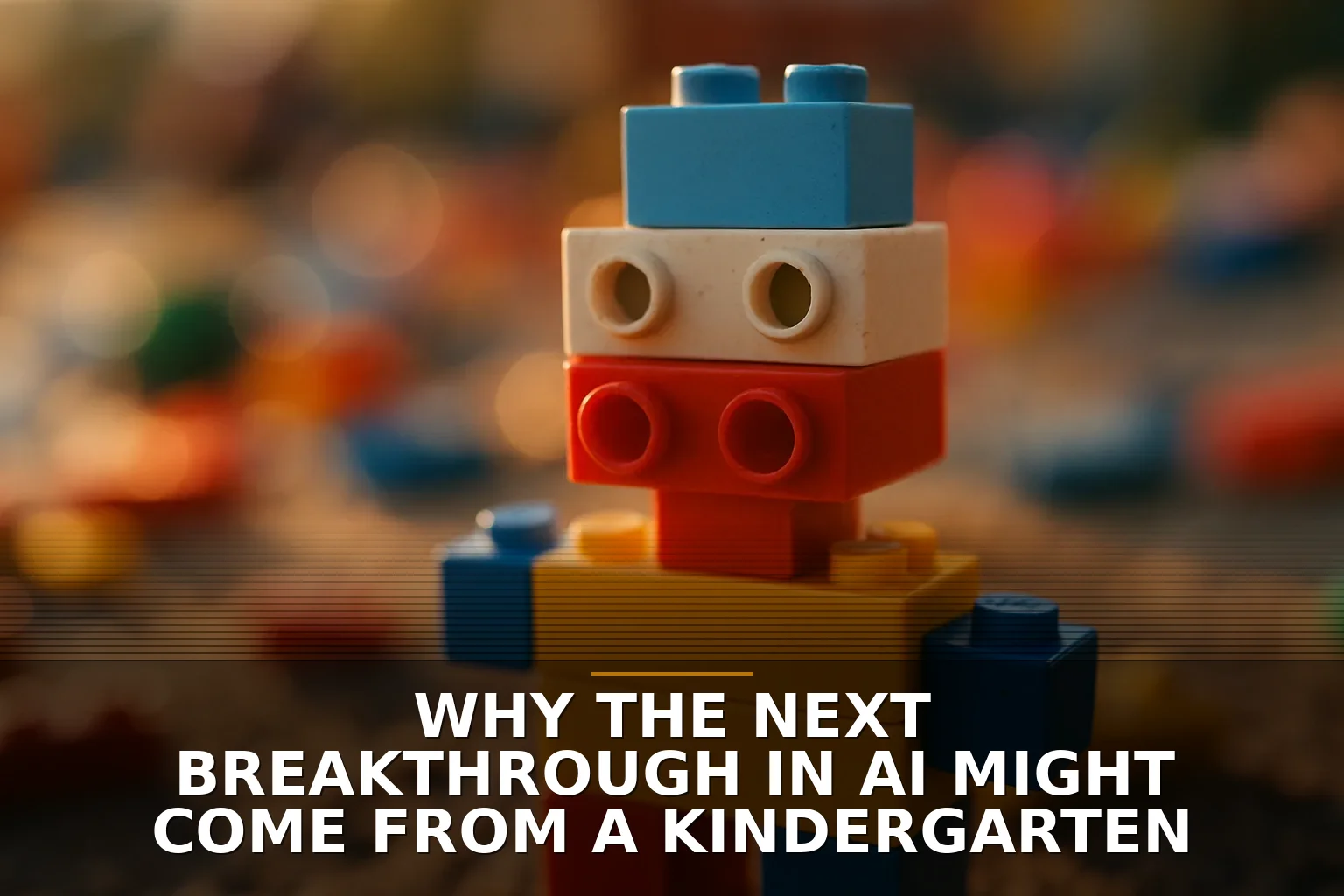
Picture this: you're in a kindergarten classroom, surrounded by chaos in its purest form. There's a flurry of mismatched shoes, colorful blocks precariously stacked, and a group of five-year-olds debating the merits of eating Play-Doh. Amidst this beautiful pandemonium, the next breakthrough in AI might just be taking shape.
Hear me out. When we think of AI advancements, we typically envision sterile labs and long rows of servers humming with data. But what if the key to the next leap in artificial intelligence lies not in silicon and code, but in the unfiltered creativity of a child's mind?
Children are the ultimate pattern recognition machines. They can spot a dinosaur in a squiggly line and turn a cardboard box into a spaceship. This ability to see beyond the obvious, to find connections and meanings where adults see none, is exactly what AI needs to break out of its data-driven algorithms and into the realm of true creativity. Imagine if AI could learn to improvise like a child playing with LEGOs, rather than just crunch numbers and solve puzzles.
Take the concept of machine creativity. Despite advancements, AI struggles with tasks that require the kind of lateral thinking kids do naturally. Researchers have already begun exploring this angle, with some studies showing that exposure to play-based environments enhances problem-solving skills in AI (Source: MIT Technology Review — https://www.technologyreview.com/2023/05/18/ai-play-based-learning/).
But there's another layer here: emotional intelligence. Kids' ability to intuitively understand complex social cues is astounding. They can read a room faster than most adults. If AI could glean even a fraction of this capability, imagine the implications for virtual assistants and other interactive technologies. It could revolutionize how machines understand human emotion, leading to more empathetic digital interactions (Source: Psychology Today — https://www.psychologytoday.com/us/blog/child-development-and-parenting/2023/06/emotional-intelligence-in-children).
Let's not forget the potential impact on design. Kindergarten environments are a hotbed of creativity and innovation, filled with quirky solutions to everyday problems. This mirrors some of the ideas we've explored in product design. If AI development drew inspiration from these spaces, we might see a wave of user-friendly, intuitive tech.
What's the real-world impact of this thought experiment? Picture customer service bots that actually understand your frustration, or educational tools that adapt to a child's learning style on the fly. The possibilities are expansive. As AI continues to evolve, perhaps it's time we look toward more unconventional sources for inspiration. After all, if children can find new ways to color outside the lines, why can't AI?
This isn't just about improving AI; it's about rethinking innovation itself. We've already seen how unexpected connections—like the link between origami and space exploration—can lead to incredible breakthroughs.
So next time you're watching a group of kids at play, remember: the greatest minds in AI could learn a thing or two from a bit of childish chaos.
What this means for your business. Kindergarten-level thinking — try the small thing, see what happens, adjust, try again — is the same shape as a good MVP build. The mistake most businesses make is assuming the only way to test an idea is to build the full thing first. The mistake most agencies make is encouraging that.
A real first version of a tool answers one question: does this approach actually work for the people who'll use it? It's small, it's rough, and it's in real hands within weeks. From there, the iterations are guided by what actually broke and what users actually wanted — which is information you literally cannot have until something real exists. We help local businesses ship that first version fast, learn from it, and decide what to build next.

Be the first to share your thoughts.