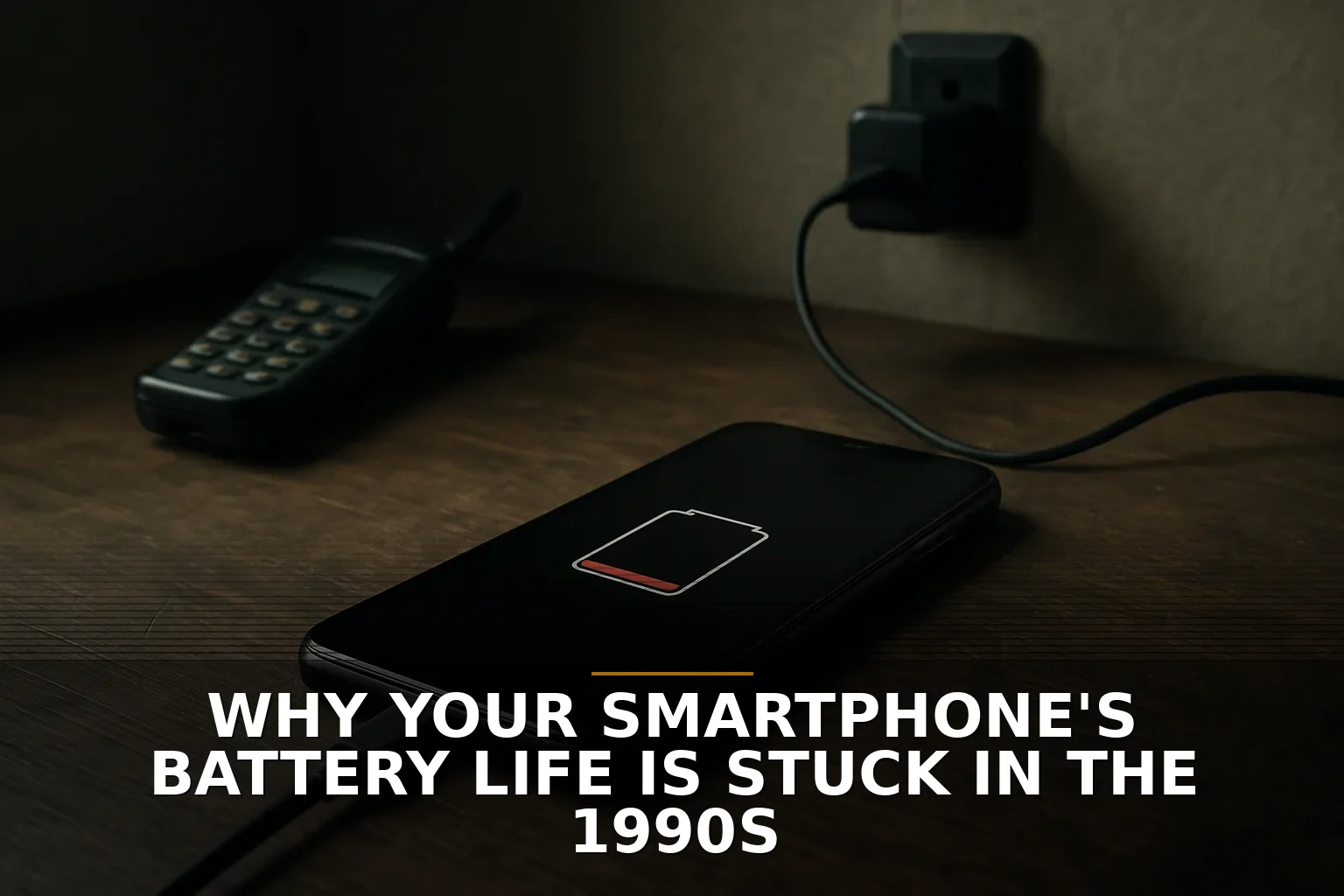
Remember when you got your first cellphone and it lasted a whole week on a single charge? If your smartphone could feel nostalgia, it would probably dream about those days too. Battery life today feels like it's stuck in the 1990s, and there's a surprisingly good reason why your most advanced gadget seems to run out of juice so quickly. Turns out, it's not the battery technology that's holding us back—it's what's powering it.
Let's start with the basics. Lithium-ion batteries, the ones in almost every smartphone, were introduced in the early 1990s. Despite being revolutionary at the time, they've been on a fairly incremental path of improvement since then. Sure, they're smaller, lighter, and more efficient now, but the fundamental technology hasn't had a breakthrough moment in decades (Inside Science — https://www.insidescience.org).
But here's the kicker: it's not that we're sitting on our hands. Battery research is hard. It's like trying to invent a time machine while only being allowed to use Legos. Despite this, there are promising technologies like solid-state batteries on the horizon, which promise better energy capacity and safety (MIT Technology Review — https://www.technologyreview.com). So, why are they not in your phone yet? Because scaling new battery tech to the level of global smartphone production is a monumental task, akin to replacing all the bridges in a city without causing a traffic jam.
Now, let's add a twist. While battery capacity has grown at a snail's pace, the power consumption of smartphones has skyrocketed. Remember when phones just made calls? Today, your device is a pocket-sized supercomputer running apps, streaming video, and pulling data from the cloud. This constant demand is why your battery icon perpetually hovers in the red, not because the battery itself is bad. It's like strapping a jet engine to a go-kart and wondering why it runs out of gas so quickly (The Verge — https://www.theverge.com).
Smartphones are designed to do more with less, cramming increasingly powerful processors into wafer-thin frames, but the trade-off is energy consumption. The irony here is delicious: in a bid to make devices smarter, we've inadvertently made them hungrier. Tech giants are more focused on cranking up performance than conserving power (Harvard Business Review — https://hbr.org). It's like a race car engineer ignoring fuel economy in pursuit of speed.
Interestingly, there's a cultural angle to this too. As users, we've grown accustomed to charging our phones daily. It's become a ritual, a modern-day sunset that signals the end of our digital day. So, in some sense, the industry has little incentive to break this pattern, because we've all just accepted it like a bad habit. This is reminiscent of how ancient myths are quietly guiding today's tech innovations.
Until a real breakthrough hits, we might have to embrace this daily dance with our chargers. Perhaps there's an opportunity here, a chance to rethink our design paradigms much like digital nostalgia reshaping modern product design. The path forward may not be in just better batteries, but in smarter design and energy efficiency.
So, while your phone might still be living in the 90s when it comes to battery life, maybe that’s not entirely accidental. It's a mix of tech limitations and cultural norms—a quirky plot twist in our love affair with technology.
What this means for your business. Phone hardware constraints are real — and they're exactly why a mobile app that respects them outperforms one that doesn't. Heavy backgrounded apps drain batteries; chatty data calls eat data plans; bloated UIs feel slow even on new phones. The customer-facing apps that get used (and don't get uninstalled in a week) are the ones that work efficiently with what the device actually has.
For local businesses considering a mobile app — for crew dispatch, customer ordering, a loyalty program, internal field tools — the question isn't whether to build it. It's whether the build respects what the phone in your customer's hand can actually handle. We build mobile apps for small businesses that take that constraint seriously, which is why the apps stay on phones instead of getting deleted.


Be the first to share your thoughts.