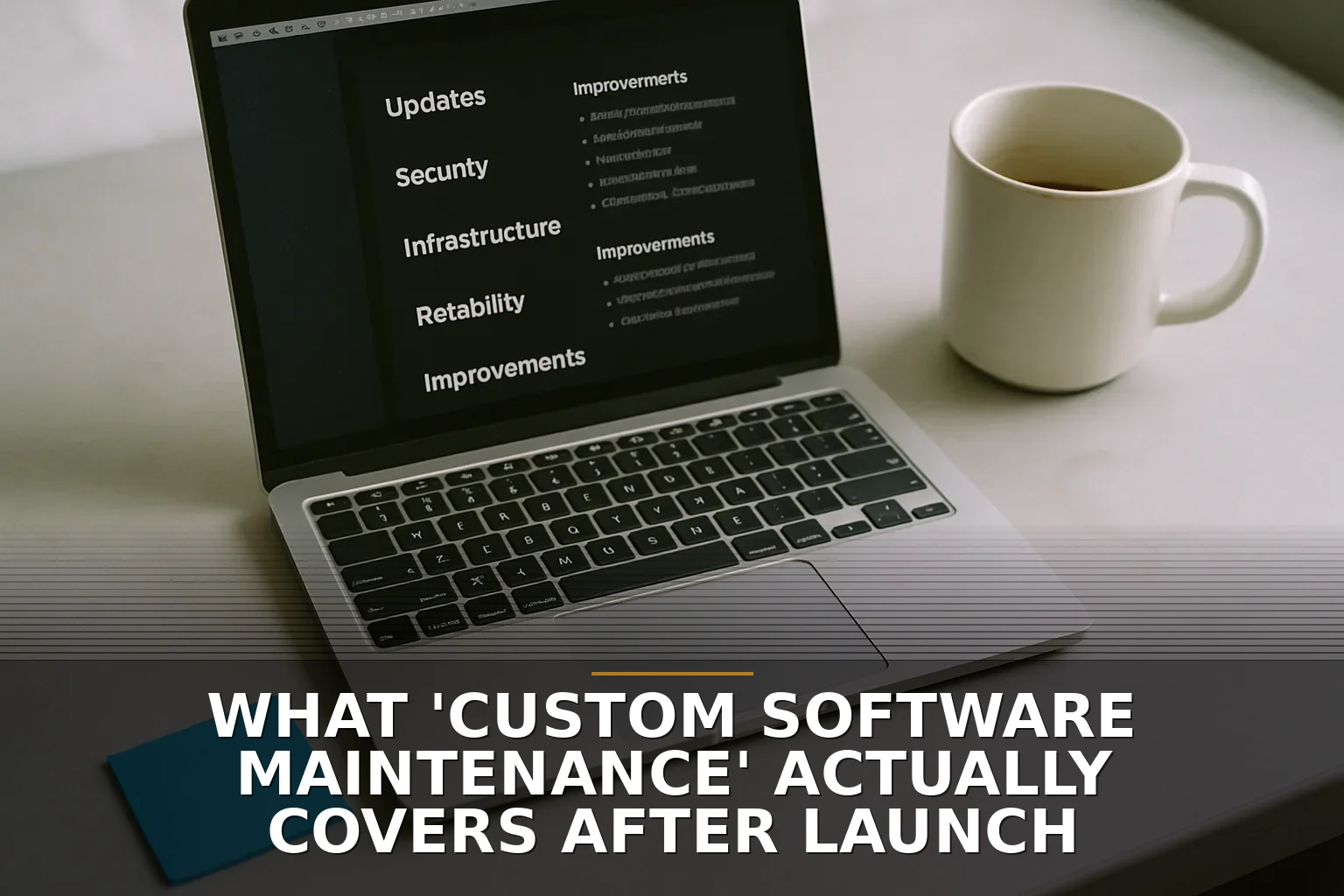
The software went live, your team is using it, and then the invoice says "maintenance." Fair question: what are you actually paying for now?
A lot of business owners hear "maintenance" and assume it means "fixing bugs if something breaks." That's part of it, but it's not most of it.
Think of custom software like a commercial building. Launch day is not the end of the project. It's the day you open the doors. After that, somebody still has to inspect the wiring, replace worn parts, patch leaks, update locks, and make sure the building still meets code when the world around it changes.
Software is the same way.
The old-school breakdown from the Software Engineering Institute is still useful here: corrective, adaptive, perfective, and preventive maintenance. That's technical language, but the plain-English version is simple.
Corrective maintenance is bug fixing. A form submits the wrong value. A report totals something incorrectly. A button stops working on mobile. This is the part people picture first, and yes, it matters. It also gets more expensive after launch, which is one reason sloppy projects are never really cheap.
Adaptive maintenance is the big one people miss. Your software depends on browsers, phones, operating systems, payment providers, email services, APIs, cloud hosting, and third-party packages. Those things change whether you like it or not. If Google changes browser behavior, if QuickBooks changes an API, if a hosting platform retires an old setup, your app may need updates just to keep working. That's why API integrations and custom apps are never truly "set it and forget it." If you want the plain-English version of that problem, read What a Software Integration Actually Is—and Why Vendors Oversimplify It.
Perfective maintenance means improving the software after real people start using it. Not because it failed — because now you can see friction. Maybe users need one fewer click. Maybe a dashboard loads too slowly. Maybe a workflow made sense on paper but causes bottlenecks in the field. That's not cosmetic fluff. That's operational improvement. I talk about that same trap in Why Software Demos Feel Great but Fail in Real Operations.
Preventive maintenance is the invisible work that smart owners usually underbuy. This includes security patches, dependency updates, backups, certificate renewals, monitoring, test coverage, cleanup of risky code, and tightening infrastructure. According to Verizon's 2024 breach report, vulnerability exploitation jumped hard year over year. And with open source components showing up in almost every modern app, outdated packages are not a side issue. They're a real business risk. OWASP has been warning about vulnerable and outdated components for years.
This is also where people confuse maintenance with support. They are not the same thing.
Maintenance is changing or protecting the system itself. Support is helping users with passwords, training, data entry mistakes, or "how do I do this task?"
Sometimes one person handles both. That does not make them the same job.
There's another piece owners should ask about: who owns post-launch responsibility? In small businesses around Northwest Arkansas, this is where projects quietly go sideways. If nobody is watching logs, renewing certificates, updating libraries, checking backups, and planning for end-of-life components, you're basically driving a delivery truck and skipping oil changes because the engine sounds fine today.
And yes, successful software often needs more maintenance, not less. More users, more data, more integrations, more uptime expectations — all of that raises the cost of keeping the machine healthy.
So when you review a proposal, don't ask only, "What's the build cost?" Ask what happens after launch, who handles it, what's included, and what gets ignored until there's an emergency. You can also read Myth: Once Software Is Live, the Hard Part Is Over if this is already sounding familiar.
Software maintenance is not a cleanup fee after the real work — it is the real work of keeping a useful business tool reliable, secure, and worth depending on.
If you're staring at software that runs the business but nobody really owns the after-launch upkeep, that's exactly where Custom Software Development usually starts.


Be the first to share your thoughts.