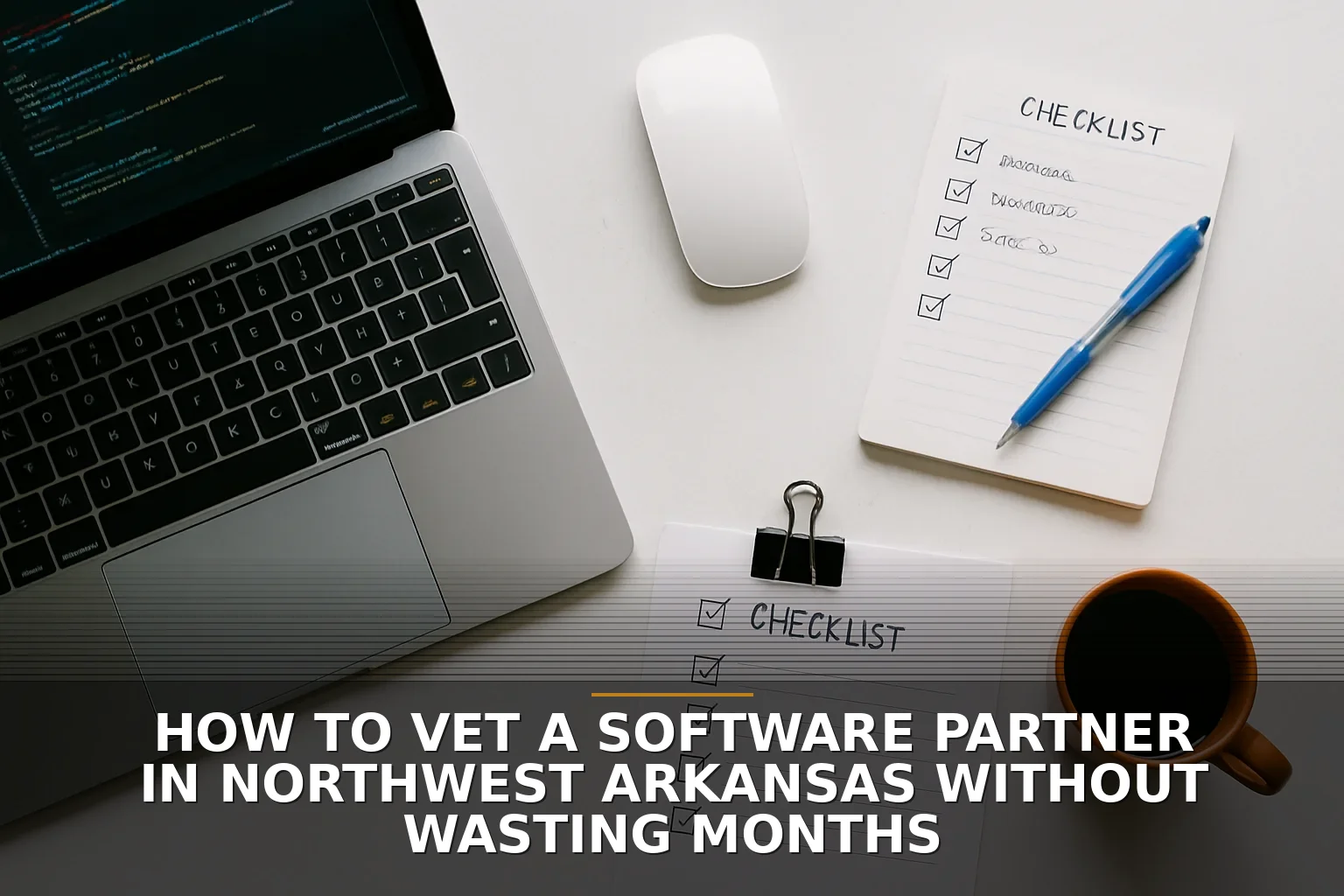
How to vet a software partner in Northwest Arkansas without wasting months
You don’t lose months because a developer writes code slowly. You lose months because you picked someone before you understood how they actually work.
Around Northwest Arkansas, it’s easy to get dazzled by a polished demo, a referral from somebody in Bentonville, or a nice-looking website from a shop that says they do everything. Don’t do that. Choosing a software partner should feel less like buying a billboard and more like hiring a general contractor for a building you’ll use every day.
If you want to move faster without making a bad hire, here’s the checklist I’d use.
1. Start with the business problem, not the software wishlist
If you tell three developers, “I need a custom app,” you’ll get three wildly different answers and none of them will be grounded in reality. Start by writing down the bottleneck: what task is slow, where data gets re-entered, who is waiting on whom, and what breaks when somebody is out sick.
That one-page summary will save you more time than ten sales calls. If you need help framing it, Before You Buy New Software, Find the Bottleneck You Actually Have is a good place to start.
2. Ask who will actually do the work
A lot of firms sell with senior people and deliver with whoever is available. That’s like meeting the head chef, then finding out your food is coming from somebody who started yesterday.
Ask directly: who writes the code, who manages the project, who makes architecture decisions, and what work is subcontracted? If the answer is fuzzy, assume the handoff after signing will be messy.
3. Look for delivery discipline, not just pretty screenshots
Portfolio images are fine, but screenshots don’t tell you whether a team plans well, tests properly, or handles changes without turning the project into a fistfight. Ask to see how they scope work, track tasks, test releases, and document decisions.
I’d rather see a clean statement of work and a sensible backlog than a flashy homepage. The best partner usually isn’t the one with the best demo; it’s the one with the best operating system for getting work done.
4. Pay for a small discovery sprint before a full build
This is the most underrated move on the list. A short, fixed-scope discovery phase tells you whether the partner can listen, challenge assumptions, document requirements, and turn a vague idea into a buildable plan.
Think of it like paying for architectural drawings before pouring concrete. If they can’t handle discovery well, they won’t suddenly become organized once the expensive part starts. That’s especially true for custom software development work.
5. Test whether they can explain trade-offs in plain English
A good software partner should be able to explain technical choices the same way a mechanic explains why one repair is worth doing now and another can wait. If every answer is jargon, they’re either hiding confusion or creating dependence.
Ask simple questions: Why this approach instead of a SaaS tool? What gets cheaper later if we build it this way? What gets harder? If they can’t explain it clearly, don’t trust them with complicated decisions.
6. Check whether they understand Northwest Arkansas business reality
Local matters some, but not in the way people think. I care less whether someone has an office in Fayetteville or Rogers and more whether they understand the kinds of businesses that shape this region—retail, logistics, supply chain, transportation, healthcare, and service operations tied to larger enterprise workflows.
That regional context matters because Northwest Arkansas isn’t a generic market. Walmart in Bentonville, Tyson in Springdale, and J.B. Hunt in Lowell have shaped the kind of operational complexity a lot of smaller local businesses deal with too. If regional familiarity matters for your project, make sure they can speak to it naturally, not just say they “know NWA.” You can also get a sense of that context through pages like /areas-we-serve.
7. Ask how they handle changing requirements and missed estimates
Projects don’t go sideways because change happens. They go sideways because nobody has a grown-up process for handling it.
Ask what happens when priorities shift, when assumptions are wrong, or when a feature takes longer than expected. If the answer is basically “we’ll figure it out,” you’re buying future headaches. This is why I tell people to read Why software estimates change when the real problem isn’t settled.
8. Do basic security diligence even on small projects
Small business owners skip this part way too often. Even a modest internal app can touch customer records, invoices, employee data, or operational systems you really don’t want exposed.
Ask where code is stored, who has access, how credentials are managed, how backups work, and what happens if there’s an incident. If they act like security is only for banks and hospitals, that’s a bad sign. 7 things to check before you trust a software vendor’s security claims covers the basics.
9. Make exit risk part of the decision
You are not just hiring for the build. You are also choosing how painful it will be to maintain, expand, or hand off later.
Ask who owns the code, what documentation you get, how deployments are handled, and whether another developer could realistically take over without rebuilding the whole thing. If leaving them would be nearly impossible, that’s not a partnership. That’s a trap.
10. Use reviews and referrals as a filter, not proof
Clutch profiles, Google reviews, and local referrals are useful for building a shortlist. They are not enough to make the decision.
Use them to narrow the field, then verify the hard stuff: process, communication, security, ownership, and who will actually be in the trenches with you. The goal isn’t to find the most impressive pitch. It’s to avoid waking up three months from now with a half-built system and a lot of polite excuses.
That’s the real game here. Not finding a perfect software partner — just finding one who can build the thing without turning your calendar into a construction delay.

Be the first to share your thoughts.