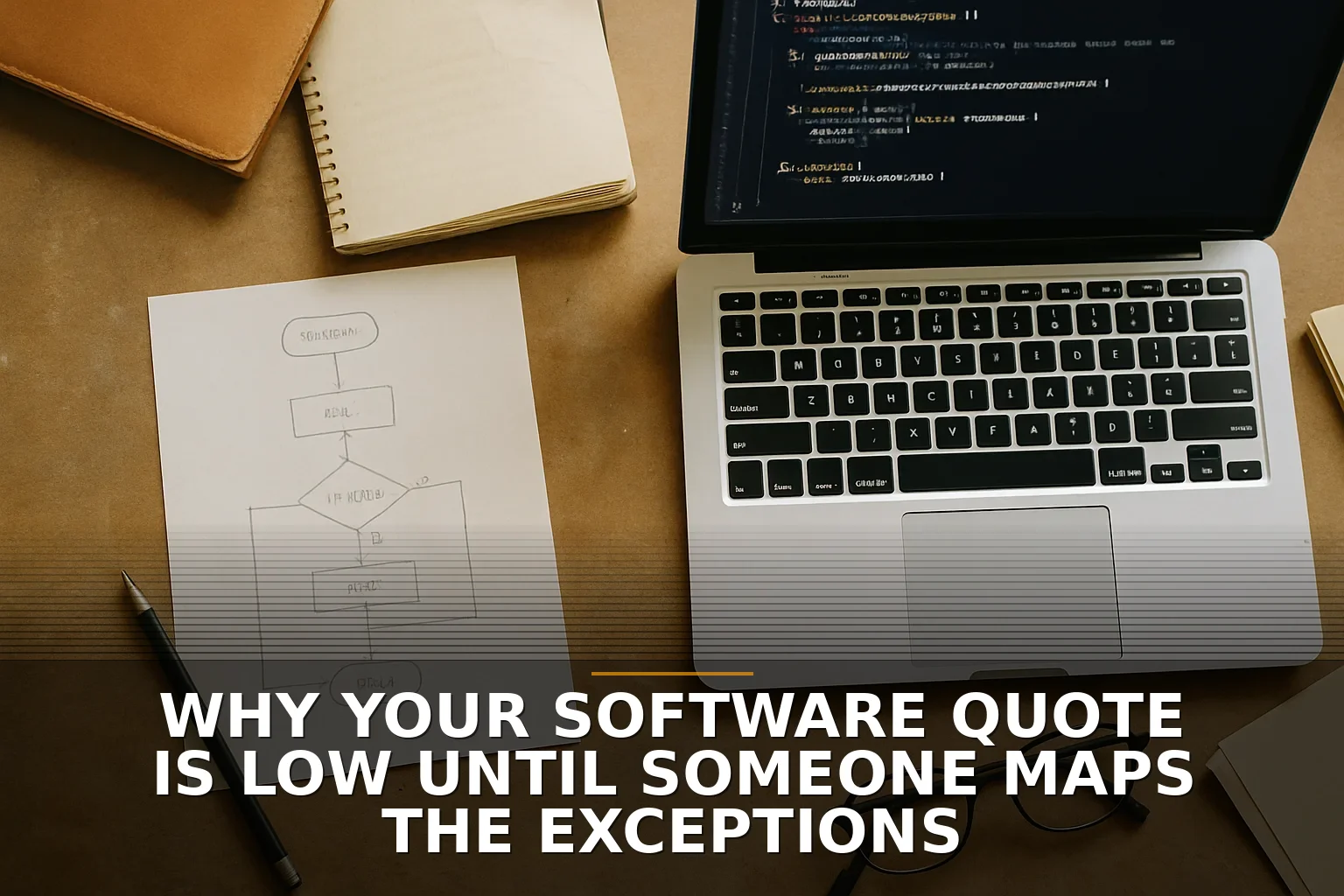
“Why is this quote so reasonable?”
That’s the question business owners ask right before a software project gets expensive.
If the quote looks low, the first thing I want to know is this: who mapped the exceptions? Not the main flow. Not the demo version where everything goes right. I mean the messy stuff. What happens when a customer pays twice? When an employee enters incomplete data? When QuickBooks is down? When two people edit the same record? When a refund needs manager approval? When an outside system sends bad data?
That’s where the real cost lives.
A low software quote usually prices the happy path. It says, in effect, “If every order is clean, every user behaves, every integration responds, and every business rule is already settled, this is the price.” That’s like a contractor quoting your remodel based on straight walls and dry lumber before anyone checks what’s behind the drywall.
The problem is most businesses do not run on straight walls.
They run on exceptions.
This is not just my opinion. The Project Management Institute has repeatedly tied missed budgets and deadlines to poor requirements management. The Standish Group has long reported that a large share of software projects end up challenged or fail outright. McKinsey and Oxford found average software cost overruns that should make any owner skeptical of a neat little number presented too early. Those overruns do not come from typing code slower than expected. They usually come from discovering reality late.
And reality is full of edge cases.
That is especially true when software touches other systems. A simple-looking API integration can turn into a pile of exception handling fast. If one system accepts partial records, another rejects duplicates, and a third has rate limits or occasional outages, your software now needs rules for retries, logging, alerts, permissions, and cleanup. If you want a plain-English version of that, read What a Software Integration Actually Is—and Why Vendors Oversimplify It.
There’s another part buyers miss: a quote is not the same as the true cost.
Sometimes a low quote is honest but shallow. Sometimes it is a sales tactic. In fixed-price bidding, some vendors price low to win the job, then make their margin on change requests once the exceptions show up. I’m not saying every low bid is a trap. I am saying you should not reward false certainty. Martin Fowler has made this point for years in different ways: early estimates are uncertain by nature, and a precise number can hide that uncertainty instead of reducing it.
This is why detailed scoping often raises the initial price but lowers the total pain. Mapping exceptions forces real business decisions: who can override what, what gets logged, what happens when data conflicts, who gets notified, and what should happen when a process breaks halfway through. A lot of “software complexity” is really unresolved policy.
If you’re in Northwest Arkansas, this matters even more because a lot of SMBs here are stitching together accounting tools, field workflows, inventory systems, spreadsheets, and customer platforms that were never designed to behave like one clean system. That’s why I tell people to read How to review a software proposal without missing the risky assumptions and 6 things to clarify before you ask a developer for an estimate before they compare bids.
If you’re paying for custom software development, don’t ask first, “What’s the cheapest quote?” Ask, “What exceptions did you include, and what did you leave out?”
That’s the right question.
Because the cheapest quote on paper is often just the one that postponed the hard thinking. Don’t buy the low number until someone has mapped the ugly parts.

Be the first to share your thoughts.