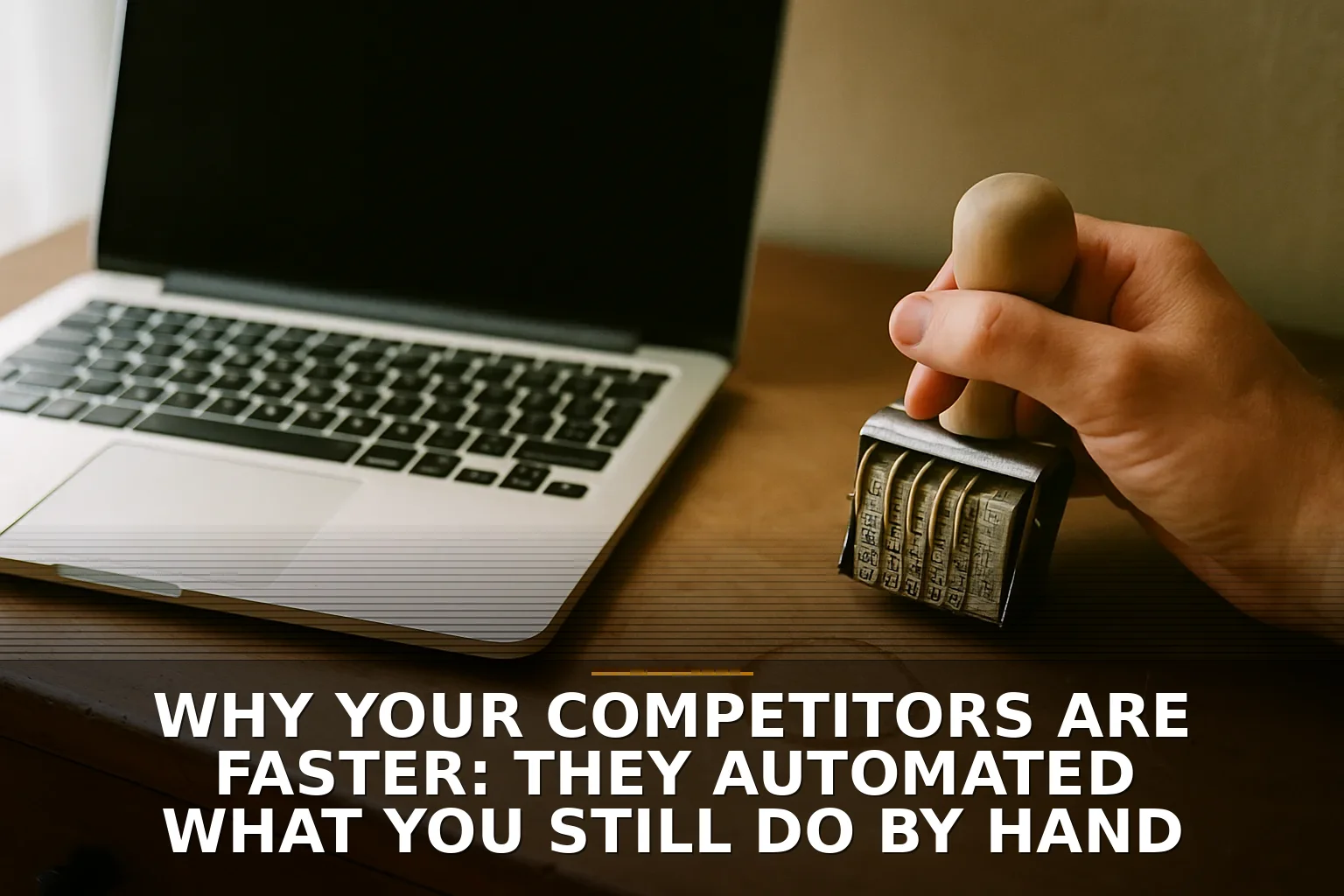
The myth: "We’re slower because my competitors have more people or bigger budgets."
I used to think that explained most of it too. Then you look closer and realize a lot of "faster" companies aren’t winning because they hired an army. They’re winning because they stopped making humans do clerk work.
Not the flashy stuff, either. I’m not talking about some sci-fi robot running the business. I’m talking about the boring middle: copying customer info from a form into a CRM, sending invoice reminders, routing approvals, updating job statuses, pulling reports, scheduling follow-ups, re-entering the same numbers into three different systems.
That’s where speed gets lost.
If your team still touches the same piece of information five times before anything happens, your competitor doesn’t need better people to beat you. They just need fewer handoffs.
Think about a restaurant kitchen. If every ticket has to be rewritten by hand, carried across the room, and checked by three people before cooking starts, the problem isn’t the chef. The problem is the line. Business works the same way. Manual steps create waiting, and waiting is what customers feel as “they’re slow” or “they’re easy to work with.”
McKinsey has estimated that about 60% of occupations have at least 30% of activities that are technically automatable with tools we already have. That sounds abstract until you translate it into normal business life: a lot of your day is probably repeatable, rules-based work that software could handle just fine.
And plenty of businesses are already moving. Deloitte found automation is either deployed or being piloted in a big chunk of companies. The problem is that small businesses often lag behind, not because they’re lazy, but because they’re patching together whatever tools they can afford. I see that a lot around Northwest Arkansas and the Ozarks: smart operators, solid businesses, but too many processes still held together by inboxes and spreadsheets.
Here’s the part I want to challenge: speed is usually a process problem before it’s a staffing problem.
If a quote sits in someone’s inbox until Tuesday, if a paid invoice has to be marked manually, if your office staff spends Friday building reports by hand, you do not have a hustle problem. You have a workflow problem. That’s why I keep pointing business owners toward things like the 3 tasks every business should automate first and the hidden cost of running your business on spreadsheets. A lot of "growth problems" are really software vs spreadsheet problems.
Now, don’t hear me saying automate everything. Don’t do that.
Automating a bad process is like paving a cow path. You get a smoother bad route. If your underlying process is messy, unclear, or full of exceptions nobody has defined, software will just help you make mistakes faster. Good business process automation starts with one question: what should happen every single time?
That’s also why the cheap fix is sometimes the right fix. A simple form, a Zap, a cleaner database, or an API integration can remove a bottleneck without turning into a giant software project. Other times, if your business has outgrown duct-taped tools, it’s time for business automation or even custom software for small business. The trick is not buying the fanciest tool. The trick is removing rekeying, waiting, and confusion.
Your competitors feel faster because they compressed the time between "customer asked" and "business responded".
That’s the whole game.

Be the first to share your thoughts.