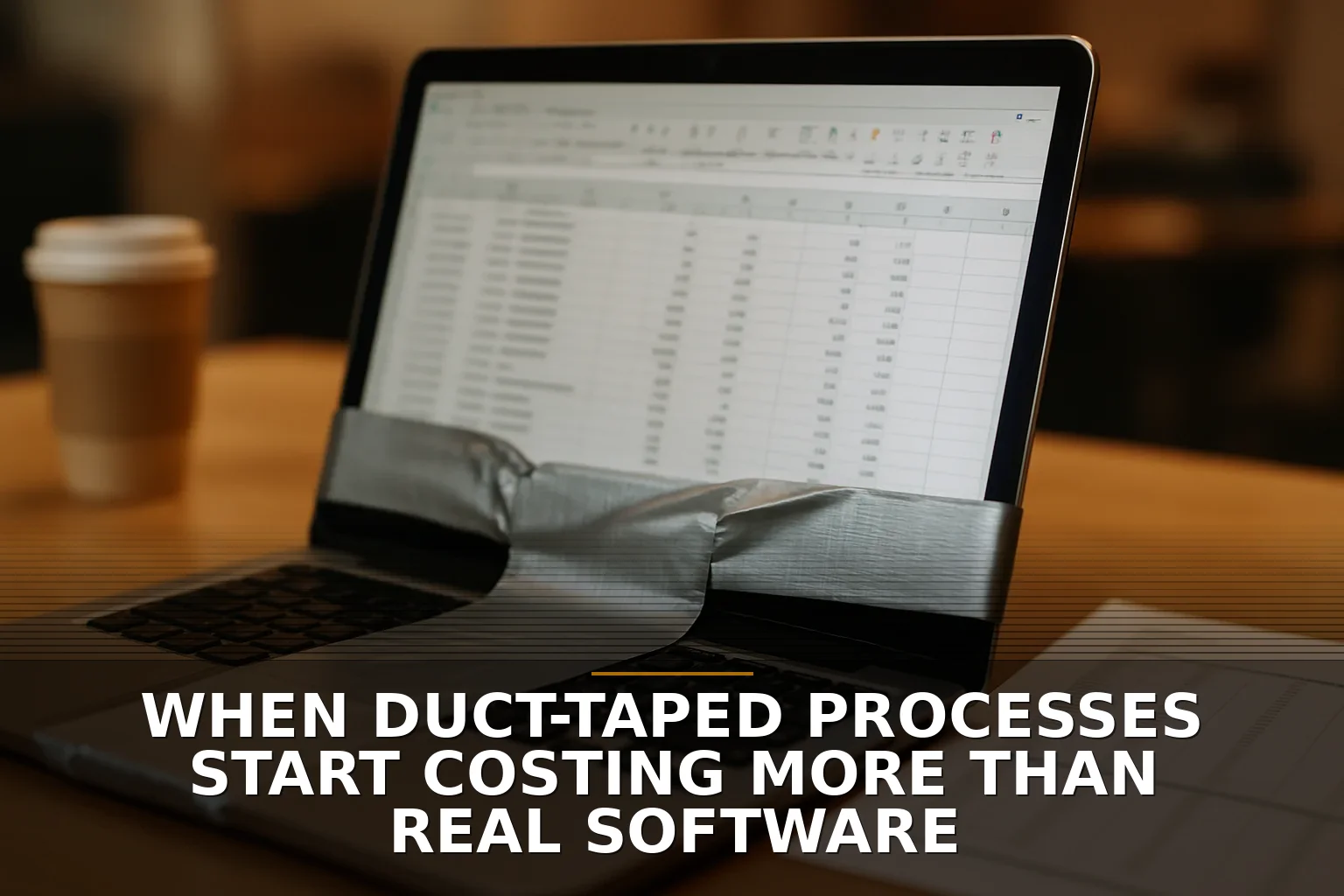
Imagine running a restaurant where whenever a table is wobbly, you fix it with a folded napkin. It works in a pinch, but what if more napkins are sliding under more tables every day? Duct-taped processes are the business world's equivalent of that quick fix. They're the stopgaps—spreadsheets, manual tasks, and patchwork systems—that keep your business moving but at a cost.
According to Forrester Research, 74% of businesses rely on at least one spreadsheet as a critical part of their operations. While spreadsheets are flexible and familiar, they can become a tangled web of inefficiencies and errors when scaled. It's like relying on paper maps in a world that has GPS; sure, you get where you're going, but not without some detours and wrong turns.
The real issue kicks in when these duct-taped processes start costing you more than investing in real software solutions. Gartner reports that poorly integrated software systems waste about 30% of IT budgets. Essentially, what seems like a cost-saving shortcut can lead to a money pit.
Let's say your business uses spreadsheets for customer management. It works until you realize you're spending hours each week manually updating data, and mistakes are slipping through. Errors lead to unhappy customers, and suddenly, your reputation and bottom line are at stake. That's where custom solutions like a custom CRM for small business come into play. They streamline processes, reduce errors, and free up your team to focus on what actually grows your business.
Here's a practical analogy: think of your business infrastructure like a house. Spreadsheets and manual processes are like wooden scaffolding; they hold up the structure but aren't meant to be permanent. Custom software? That's your concrete foundation—solid, reliable, and built to last.
Now, some might argue that duct-taped solutions offer flexibility and quick adaptability in a fast-paced world. While there's some truth there, consider McKinsey & Company’s finding that businesses digitizing their processes see a 20-30% boost in productivity. Digitized processes not only cut down on inefficiencies but also reduce risks, like the $4.45 million average cost of data breaches reported by the Ponemon Institute.
The trade-offs are clear: short-term fixes might work now, but they can lead to long-term headaches. When duct-taped processes begin to bleed resources and morale, it's time to evaluate business process automation. Start by identifying which parts of your business to automate to reduce manual work, or explore custom software development as a more sustainable solution.
So, when you're back at your desk, ask yourself: are your business processes wobbling on a stack of napkins, and what will it take to pour that concrete foundation?

Be the first to share your thoughts.