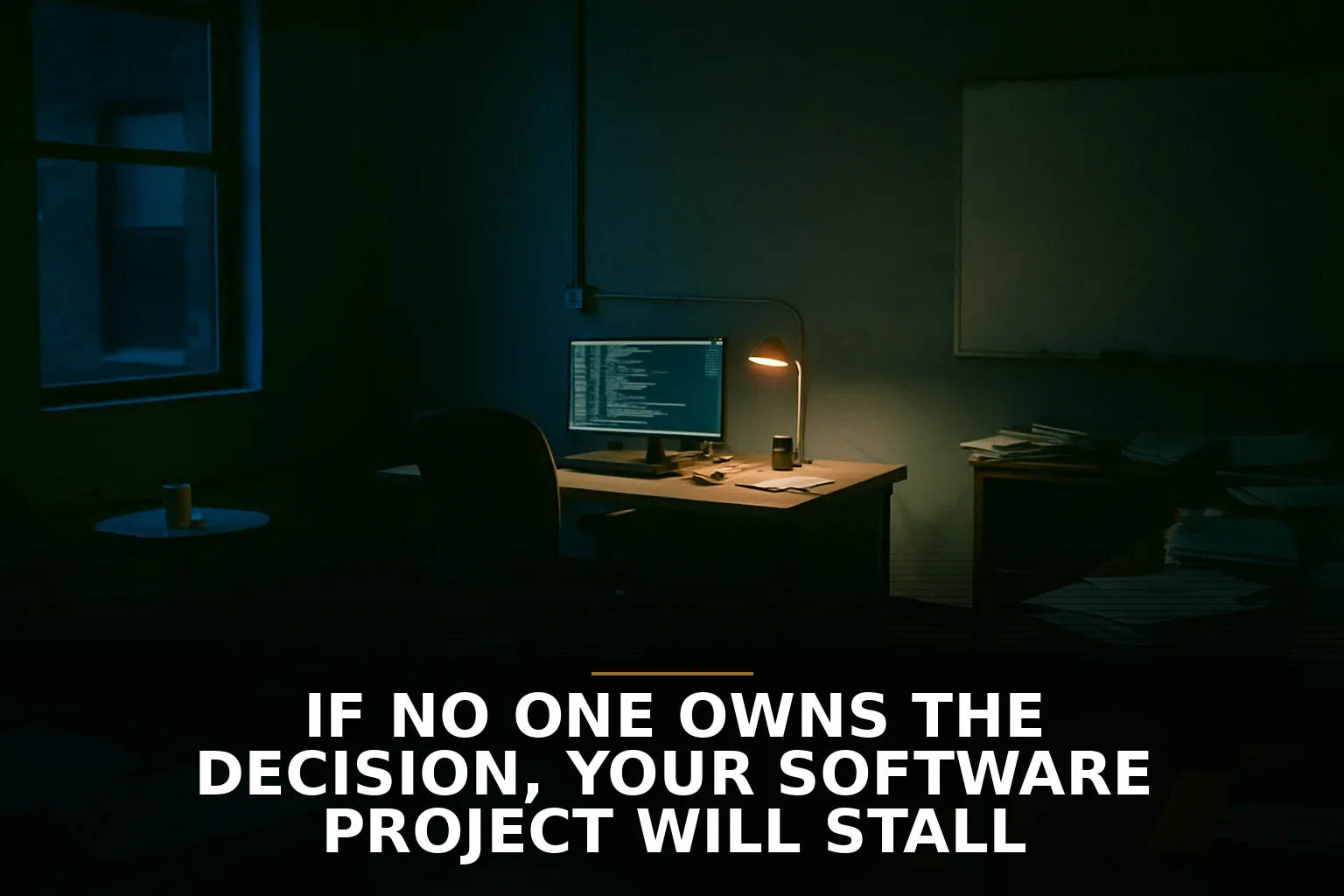
“We’re waiting on a few people to weigh in” is one of the most expensive sentences in software.
If your project needs five people to agree before anything moves, no one owns the decision. And when no one owns it, the project stalls.
I see this a lot with custom software. The business owner wants the system to help sales. Operations wants different rules. Accounting needs better reporting. The office manager has strong opinions because they’ll live in it every day. Everybody should have input. That part is healthy.
But input is not ownership.
A software project needs one person who can say yes, no, not now, and here’s why. Not a committee. Not “the team.” Not a weekly meeting where everyone nods and then sends follow-up objections two days later.
Think about building a restaurant kitchen. You absolutely ask the chef, the servers, the dishwasher, and the owner what they need. But if nobody has final say on layout, equipment, and budget, you don’t get a better kitchen. You get three revised floor plans, a delayed opening, and a lot of frustration.
Software is the same.
The research backs this up. The Standish Group has long tied project success to executive support, user involvement, and clear requirements. Those three things sound separate, but they all break down when decision rights are fuzzy. The Project Management Institute has also pointed to poor requirements management as a major reason projects fail. In plain English: if nobody can make the trade-off call, requirements sit there and rot.
That’s why Scrum names a single Product Owner. Not because collaboration is bad, but because decisions made by committee are slow and usually weaker. McKinsey and Oxford research on large IT projects found overruns and underdelivery are common, and weak governance shows up again and again in those messes. Same story, bigger budget.
Here’s the part business owners miss: naming an owner is not enough if they have no authority. If your “project lead” still has to get approval from the founder, the ops director, and the finance person every time scope changes, they’re not the owner. They’re a messenger.
That’s where a lot of projects get stuck in “awaiting alignment.” That phrase usually means one of two things: either the requirements were never clear in the first place, or nobody has permission to choose between speed, cost, and complexity. If that sounds familiar, read Myth: If your team agrees verbally, your software plan is clear and How to tell if your software requirements are ready to build.
If you’re building custom software for a business in NW Arkansas or anywhere else, set this up before development starts:
- One person is accountable for product decisions
- That person can actually prioritize scope
- Budget approvals have a clear path
- Technical decisions have a named owner too
- Everyone else gives input on a deadline, not forever
You can still be collaborative. You should be. End users need a voice. Finance needs visibility. Leadership needs to understand trade-offs. But collaboration should inform decisions, not replace them. If you want more on where projects bog down, read What changes mid-project usually mean and what to do next.
Here’s my honest recommendation: before you build anything, write down the top five decisions your project will require and put one name next to each. If you can’t do that, don’t start yet.

Be the first to share your thoughts.